
Contrave Compared to Phentermine: How to Decide
speciality medications
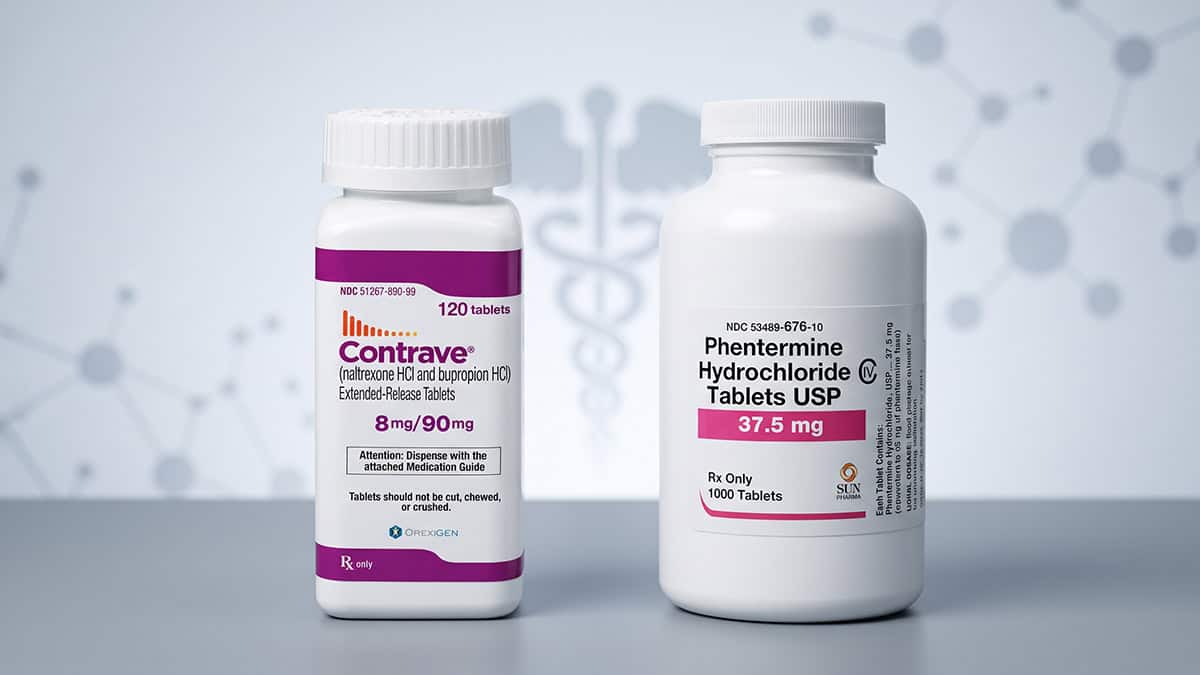
Contrave – a combination medication bringing weight management patients the benefit of two drugs – and phentermine, an older medication associated with weight loss, are two meds that you've probably seen if you've spent much time looking for prescription medications for weight loss.
They both do their job.
They're both relatively affordable, especially if you know where to look. (More on that later.)
But they do work in very different ways...and they're certainly not interchangeable.
So, which is the best for you?
(Perennial note that the only way to tell which drugs are best for you and your unique goals is to talk to your doctor.)
However, going to your doctor with an understanding of your options and what each offers – so, in this case, Contrave vs. phentermine: what's the difference? – can be hugely helpful.
It's also helpful to go to that appointment with a specific idea of what you're looking for in a weight management med.
For example, some people are looking for long-term support to help manage appetite and food cravings.
Others may benefit from a medication intended for shorter-term use that primarily suppresses appetite.
Factors specific to you such as your existing medical conditions, your other medications, side effects that you can deal with vs. those that are non-starters for you, and your insurance coverage will all play a role in determining your most appropriate treatment.
In this guide, we'll compare how Contrave and phentermine work, discuss their potential benefits and side effects, review important safety considerations, and explain why the "best" medication depends on the individual rather than the medication alone.
Let's get started.
What Is Contrave?
Contrave is a prescription medication approved for chronic weight management in certain adults who are managing obesity or seeking safe weight loss.
Typically, doctors will prescribe Contrave to those who also have at least one other weight-related health condition, like high blood pressure, type 2 diabetes, or high cholesterol.
As we mentioned above, Contrave is a combination medication.
It combines two well-known medications into one ER (or extended-release) tablet for easy dosing.
Those two medications are:
- Bupropion, an antidepressant that's also used to help people stop smoking.
- Naltrexone, a medication commonly prescribed to treat alcohol and opioid dependence.
Together, these medications work on areas of the brain involved in appetite regulation, food cravings, and reward.
So, rather than simply suppressing hunger, Contrave may help reduce cravings and make it easier for some people to maintain healthier eating habits over time.
You can buy brand-name Contrave right here, through NorthWestPharmacy.com, for about $2.75 per pill.
What Is Phentermine?
Phentermine is another prescription medication used to support weight loss.
It works very, very differently when compared to Contrave.
Phentermine belongs to a class of medications known as sympathomimetic amines, which stimulate the central nervous system.
By increasing the release of certain brain chemicals, phentermine helps suppress appetite, making some people feel less hungry between meals.
Unlike Contrave, phentermine is generally approved for short-term use, and specifically as part of a comprehensive weight-loss program.
Because phentermine has stimulant-like effects, healthcare providers carefully evaluate whether it's appropriate based on a person's medical history. Certain cardiovascular conditions, uncontrolled high blood pressure, hyperthyroidism, glaucoma, and a history of substance misuse may influence whether phentermine is a suitable option.
Contrave vs. Phentermine: How They Work (Compared)
Both medications support weight loss.
Both medications do so very differently. One primarily targets appetite regulation and food cravings through multiple brain pathways, and the other acts mainly as an appetite suppressant through central nervous system stimulation.
Here's a little more about both treatment strategies:
How Contrave Works
Contrave combines bupropion and naltrexone. You can get them separately, of course, and some people do (under the explicit guidance and oversight of their doctor).
Bupropion helps stimulate nerve cells within the hypothalamus, a region of the brain that plays an important role in appetite regulation.
Naltrexone complements this effect by blocking certain feedback signals, helping sustain the activity of these appetite-regulating pathways.
So, all told, rather than increasing calorie burning or preventing calorie absorption, Contrave works by helping some people consume fewer calories through changes in appetite and eating behavior.
How Phentermine Works
Phentermine stimulates the central nervous system, increasing the release of certain neurotransmitters that reduce feelings of hunger.
As a result, many people who take phentermine feel less hungry and may, therefore, find it easier to eat smaller portions.
Because of its stimulant effects, phentermine may also increase alertness or energy in some individuals.
However, those same effects can contribute to side effects such as nervousness or difficulty sleeping.
Which Medication Is More Effective?

...for you?
...personally?
Again, the answer to this question can only be found in a consultation with your doctor, who knows things like the other medications you're taking and how they might interact with phentermine or Contrave.
That said, we can give you some information that could help you and your doctor make that decision.
As a baseline, both medications have been shown to support weight loss when combined with healthy eating, increased physical activity, and other lifestyle changes.
The factors you'll want to consider when talking with your doctor about Contrave vs. phentermine include your:
- Starting body weight
- Dietary habits
- Physical activity level
- Other medical conditions
- Medication adherence
- Individual response to treatment
Notably, your healthcare provider won't choose between these medications based solely on the amount of weight you're hoping to lose.
They should select your med based on your individual circumstances, including your health goals, your starting medical condition, and your tolerance for certain side effects.
Which, on that note, let's talk about that.
Contrave vs. Phentermine Side Effects
Like all prescription medications, both Contrave and phentermine can cause side effects.
However, because they work differently, the types of side effects people experience may also differ.
Common Contrave Side Effects
Since Contrave works on the digestive and nervous systems, the side effects you can expect on Contrave are those affecting those systems.
These include:
- Nausea
- Constipation
- Headache
- Dry mouth
- Dizziness
- Difficulty sleeping (insomnia)
Some people also experience vomiting, diarrhea, increased sweating, or mild anxiety, particularly during the first few weeks of treatment.
In most cases, after those first few weeks of treatment, your body adjusts and you'll feel better.
Common Phentermine Side Effects
Because phentermine is a stimulant, its side effects often reflect increased activity within the central nervous system.
Common phentermine side effects include:
- Dry mouth
- Difficulty sleeping
- Nervousness
- Restlessness
- Increased heart rate
- Elevated blood pressure
- Heart palpitations
Although they're not specifically nervous-system-related, some patients do also report dizziness or constipation when taking phentermine.
Who May Be a Better Candidate for Contrave vs. Phentermine?
It's not a super satisfying answer, but there's really no universal, objective winner in the Contrave vs. phentermine comparison...
...but there's probably a best medication for you, uniquely, which can be very satisfying.
When your doctor is determining which medication is best for you, they'll think about things that are special and specific about you!
Largely speaking, though, there are basic categories of patients who might be best suited for one over the other.
For example:
A healthcare provider may consider Contrave for someone who...
- Is seeking a medication approved for long-term weight management, or
- Struggles with food cravings or reward-driven eating, or
- Does not have contraindications to either bupropion or naltrexone.
Phentermine may be considered for someone who...
- Is looking for short-term appetite suppression as part of a broader weight-loss program, or
- Does not have cardiovascular conditions or other contraindications to stimulant medications, or
- Is an appropriate candidate based on their overall medical history.
These are, of course, broad examples rather than strict rules.
The ultimate decision (which, again, you and your doctor will make together!) depends on a variety of factors, including your weight-loss goals, other health conditions, current medications, and how you respond to treatment.
Safety Considerations for Both Contrave and Phentermine
Safety is your most important decision-maker when comparing Contrave vs. phentermine for your health goals.
While both medications can be effective tools for weight management, neither is appropriate for everyone.
Before prescribing either medication, your healthcare provider will review your medical history, current medications, and any conditions that could increase your risk of complications.
Safety Considerations for Contrave
Because Contrave contains bupropion and naltrexone, it has several important contraindications – or situations in which somebody shouldn't take it – and precautions.
For example, Contrave is generally not appropriate for people with:
- A seizure disorder or a history of seizures
- Uncontrolled high blood pressure
- Certain eating disorders, such as bulimia or anorexia nervosa
- Current opioid use or opioid dependence
- Recent use of monoamine oxidase inhibitors (MAOIs)
Safety Considerations for Phentermine
Phentermine's stimulant effects mean it has a different set of precautions.
Healthcare providers may determine that phentermine isn't appropriate for people with certain cardiovascular conditions, including uncontrolled hypertension or significant heart disease. They might also determine that it's not necessarily the best fit for individuals with hyperthyroidism, glaucoma, or a history of substance misuse.
Also, since taking phentermine can increase your heart rate and your blood pressure, your doctor will likely ask you to commit to routine monitoring, just to make sure you're safe.
This can feel like a lot (and it is), but just remember: More information is better, and it's just a way for your healthcare team to make sure your medication is working for you and to catch anything that could possibly be unhelpful as early as possible.
Cost and Insurance Considerations: Contrave vs. Phentermine
Today, in the 2020s, it's impossible to ignore that one of the biggest reasons someone might pick one medication over the other – especially if they do similar things, at a macro level – is their cost.
Phentermine has been available for many years as a generic medication. That means that it's (usually) fairly easy to find at an accessible cost.
Contrave, on the other hand, is a brand-name combination medication. If you're prescribed it and choose to take it, your out-of-pocket costs for that treatment will likely be much higher, even with stellar insurance coverage.
That is, of course, not the end of the cost discussion. Paying for prescription medications in America can be very complex. It's not always easy to see a simple, straightforward price for the medication you'll be taking.
There are many, many factors that will go into the price you'll pay! These include:
- Your insurance plan
- Prescription drug benefits
- Pharmacy pricing
- Manufacturer savings programs
- Length of treatment
Because pricing varies considerably, it's always worth comparing your options before starting therapy.
It's also worth seeking out an accessible pharmacy where you can actually see the price you'll pay for generic and brand prescription medications in just a few clicks.
Here, through NorthWestPharmacy.com, you can easily see exactly how much you'll pay (and how much you'll save!) for both Contrave and phentermine on our easy-to-navigate medication pages.
Taking Contrave vs. Phentermine for Safe Weight Management

Wondering which is truly, objectively best – Contrave vs. phentermine?
Unfortunately, there's no single answer to that question.
But that's a good thing.
When you and your doctor discuss the best meds for weight management for you, you'll work together to identify your goals, reasons you might do best with one med or the other, and compile an ongoing treatment plan that should work for you.
After all: Both Contrave and phentermine can support weight loss, but they do so through different mechanisms and are intended for different treatment situations.
Contrave targets appetite regulation, food cravings, and reward pathways and is approved for chronic weight management.
Phentermine primarily suppresses appetite through central nervous system stimulation and is generally intended for short-term use.
If you're deciding between these medications, an open discussion with your healthcare provider is the best place to start. Ask them the actual questions that are on your mind, talk until you feel comfortable with the choice you're making, and then make sure you get a valid-updated prescription for either Contrave or phentermine. Once you have that, you can head to our Contrave page, hit "add to cart" next to your required dosage, and follow the easy process to check out in just a few minutes.
Everyone here at NorthWestPharmacy.com looks forward to supporting you and your healthcare goals.


