
Insulin Types Explained: These Charts Make It Easy to Understand
speciality medications

Insulin is often talked about like it’s one single medication.
But … if you’ve ever looked at a prescription, an insulin box label, or a diabetes forum, you already know that that’s just not how it feels in real life.
There are many types of insulin, each designed to work at a different speed and for different purposes.
That can be helpful, but it’s also more than a little confusing.
For visual learners, locating a reliable chart about the types of insulin can really, really help people see how each insulin type compares.
This guide is built around that idea.
Instead of asking you to memorize medical terms, we’ll use clear, visual-friendly explanations to walk through insulin types step by step. The charts that accompany this article are designed to show you what matters most:
How fast an insulin starts working, when it’s strongest, and how long it lasts.
(Once those pieces click, insulin starts to make a lot more sense.)
You’ll see several charts throughout this guide, including:
- A timing chart that compares how different insulin types behave in the body
- A clear insulin names chart that connects categories to real medication names
- A short acting vs long-acting insulin comparison
- A quick guide to which types of insulin are commonly used in type 1 vs type 2 diabetes
You don’t need a medical background to follow along.
If you understand the idea of something working fast versus slow, or lasting a short time versus lasting all day, you already have everything you need.
Types of Insulin: The Big Picture (And Why There Are So Many)
Insulin types exist because blood sugar patterns aren’t one-size-fits-all.
In a person without diabetes, the body releases insulin in two main ways: a small, steady amount all the time, and quick bursts when food is eaten.
Insulin therapy is designed to mimic those natural patterns as closely as possible, even though it’s delivered by injection or pump.
That’s where the different “speeds” of insulin come in.
Some insulin is meant to act quickly to cover meals or correct high blood sugar.
Other insulin is designed to work slowly and steadily in the background, helping keep blood sugar stable between meals and overnight.
Trying to use one type of insulin to do every job would be like using only one gear on a bike: Technically possible, but much (much) harder than it needs to be.
When you look at any chart of insulin types, you’ll see the same three timing terms repeated.
Understanding these makes every chart easier to read:
- Onset: how soon the insulin starts lowering blood sugar after you take it
- Peak: when the insulin is working its strongest
- Duration: how long the insulin continues to have an effect
Visually, insulin timing is often shown as a curve.
The curve rises when the insulin starts working, reaches its highest point at the peak, and then tapers off as it wears away.
Some curves are steep and short.
Others are flatter and stretch across most of the day.
Insulin with a fast, sharp curve tends to work well for meals.
A long, gentle curve works better for background coverage.
Seeing those curves side by side is one reason why insulin charts are so helpful.
Types Of Insulin Chart: Rapid-Acting, Short-Acting, Intermediate, Long-Acting, Ultra-Long
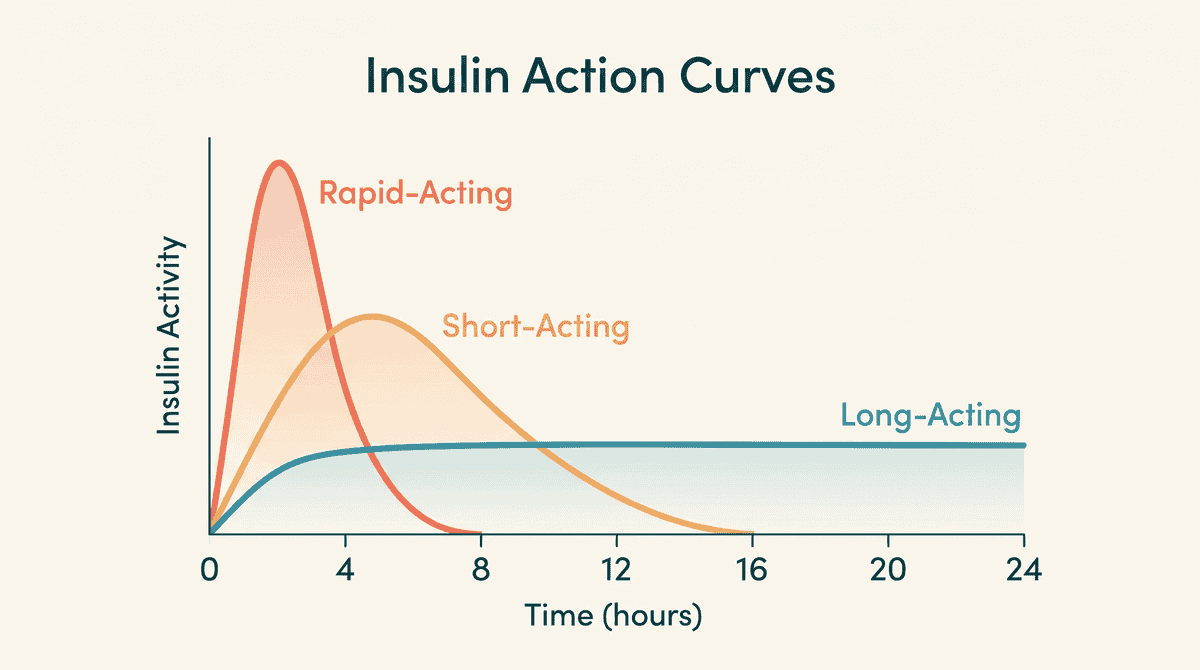
Seeing all insulin categories laid out side by side makes it easier to understand why your specific version of insulin was chosen for you, uniquely, and what job it’s trying to do for you.
Below, we’ll walk through each category in plain language so the chart is easy to interpret.
Rapid-Acting Insulin (Mealtime “Fast Movers”)
Rapid-acting insulin is designed to work quickly.
It’s commonly used to cover meals or to correct high blood sugar levels.
Typical Use Guidelines for Rapid-Acting Insulin
- This type of insulin is usually taken right before eating or with the first bite of a meal (depending on individual guidance, of course – make sure to follow your healthcare team’s guidance).
- This type of insulin is commonly used in insulin pumps.
Why Rapid-Acting Insulin Is So Useful
Rapid-acting insulin closely matches how blood sugar rises after eating.
In the chart, you’ll see its curve climb quickly and fall off sooner than other types, which helps reduce long “tails” of insulin activity after meals.
Short-Acting Insulin (Regular Insulin)
Short-acting insulin has been around longer and works more slowly than rapid-acting options.
Typical Use Guidelines for Short-Acting Insulin
- This type of insulin can provide some meal coverage when patients aren’t using rapid-acting insulin.
- It can provide support in situations where timing meals in advance is possible
What to Know About Short-Acting Insulin
Because short-acting insulin takes longer to start working, meal timing matters more.
As you’ll see on the chart, its curve rises later and stretches out longer, which can make dosing less flexible for some people.
Intermediate-Acting Insulin (The “Middle” Option)
As its name implies, intermediate-acting insulin sits between short- and long-acting options.
Typical Use Guidelines for Intermediate-Acting Insulin
- Intermediate-acting insulin can provide background (sometimes referred to as “basal”) coverage in some people’s care regiments.
- Sometimes, doctors may advise using this type of insulin with shorter-acting insulin strategies.
Long-Acting Insulin (Basal or Background Coverage)
Long-acting insulin is designed to provide steady insulin levels throughout the day and night.
Typical Use Guidelines for Long-Acting Insulin
- This type of insulin is generally taken once-daily (sometimes, depending on the patient, twice-daily).
- Its main goal is to help the patient maintain baseline blood sugar stability
As you can see, on the chart, long-acting insulin appears as a smooth, flatter curve.
Ultra-Long-Acting Insulin (The Longest Tail)
Ultra-long-acting insulin extends basal or background coverage even further than “regular” long-acting insulin.
Why Ultra-Long-Acting Insulin Is So Helpful
For some people, this extended, steady profile helps reduce day-to-day variability and allows more flexibility in dosing timing.
Insulin Names Chart: Common Insulin Names By Type (What People Mean When They Say “Insulin Names”)
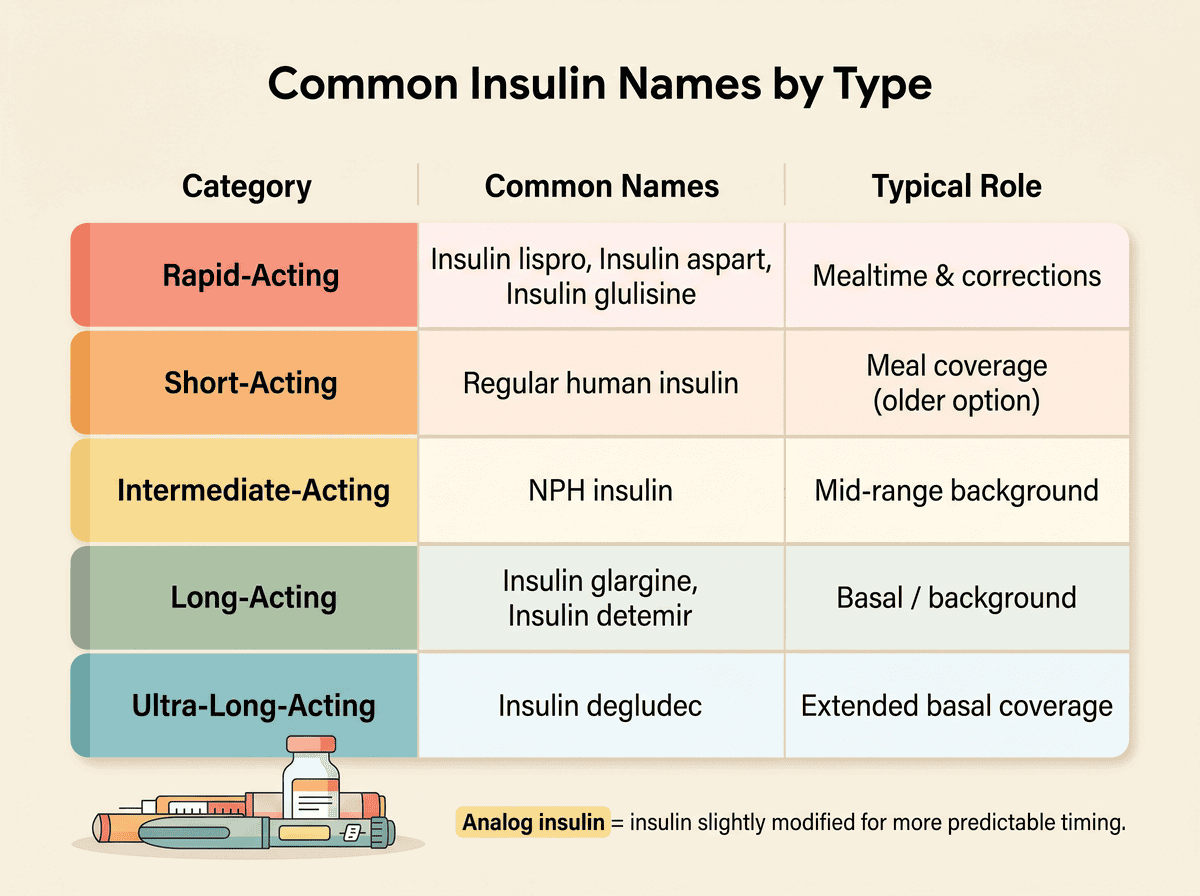
Once you understand the different types of insulin, the next question is usually something like, “Okay … but what are the actual insulin names?”
This is where many people (understandably!) get confused, because prescriptions, pharmacy listings, and online discussions often use brand names, generic names, or category labels interchangeably.
Here, we’ve provided a simple chart that translates insulin categories into recognizable medication examples, organized in a simple grid: type of insulin, common names, and what role it usually plays.
Rapid-Acting Insulin Names
These are commonly used for meals, corrections, and insulin pumps.
- Insulin lispro
- Insulin aspart
- Insulin glulisine
You may see these listed under different brand names depending on region and formulation, but they all fall into the rapid-acting category.
Short-Acting Insulin Names (Regular Insulin)
These are older formulations that act more slowly.
- Regular human insulin
Short-acting insulin is still used in some situations, but its timing requires more planning compared to rapid-acting options.
Intermediate-Acting Insulin Names
These provide mid-range background coverage.
- NPH insulin
Long-Acting Insulin Names
These are commonly referred to as basal insulin.
- Insulin glargine
- Insulin detemir
Ultra-Long-Acting Insulin Names
These extend basal coverage even further.
- Insulin degludec
(Remember, in the charts, these appear as the flattest and longest-lasting curves.)
Also remember, as you look through these charts and any other resources you find online, that the same insulin may be listed under different names depending on how it’s labeled, marketed, or dispensed.
What “Analog Insulin” Means (In Plain English)
As you learn more about the different types of insulin, you may see the term “analog insulin.” (This will especially be the case if you’re researching rapid-acting and long-acting options.)
Analog insulin is insulin that’s been slightly modified to behave more predictably in the body.
For example, insulin might be – again, slightly – modified to start working faster, or to have a flatter, steadier effect on a patient’s blood sugar.
Many clinicians prefer recommending analog insulin to their patients because, in some cases…
… Its timing is more consistent,
… It allows greater flexibility around meals, and
… It may reduce unexpected peaks for some people!
Type 1 Diabetes Insulin Vs Type 2 Diabetes Insulin: Who Uses What (And Why)
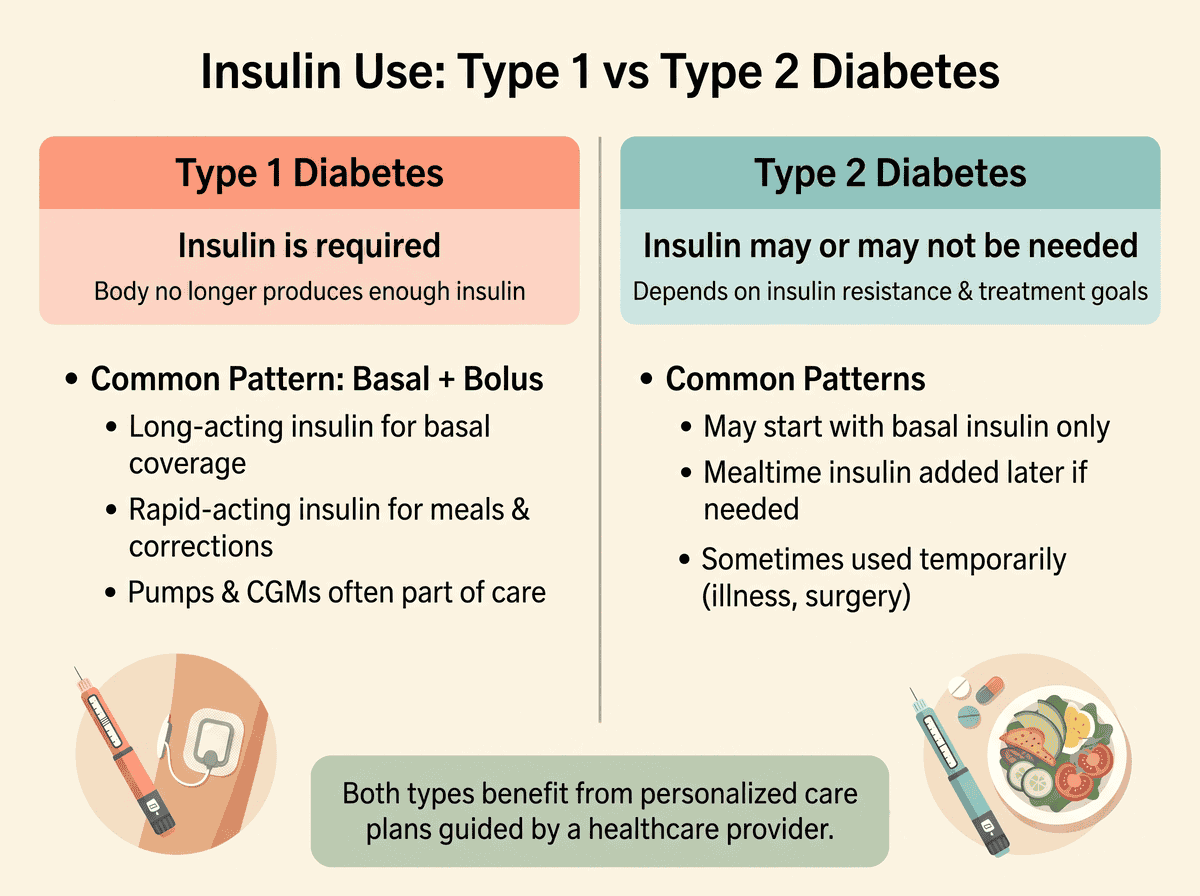
If you’ve already been diagnosed with diabetes and are working with a doctor to pursue insulin-supported diabetes care, you may not particularly be wondering about which form of diabetes you have or the specific type of insulin you’re taking – it’ll be right there in your medical history and on your prescription.
That doesn’t mean you won’t have questions about why your type of diabetes matches with a specific type of insulin.
And if you’re a caretaker or a loved one of someone with diabetes, you might naturally wonder “what type of diabetes needs insulin” as you learn more about the best ways to be there for the diabetes patient in your life.
These charts should help.
Which Type Of Diabetes Needs Insulin?
Wondering which type of diabetes needs insulin treatment?
Here’s your quick answer:For Type 1 diabetes: Insulin is required because the body no longer produces enough insulin on its own.
The goal of type 1 diabetes insulin therapy is to replace the insulin that the body is missing.
For Type 2 diabetes: Insulin may be used, but not everyone with type 2 diabetes needs it.
Use depends on insulin resistance, how much insulin the body still produces, and overall treatment goals.
Common Insulin Patterns For Type 1 Diabetes
For people with type 1 diabetes, insulin therapy and their administration schedule, in particular, are typically designed to replace both background and meal-related insulin needs.
- A basal + bolus approach is common.
- Long-acting or ultra-long-acting insulin provides baseline (basal) coverage.
- Rapid-acting insulin covers meals and corrections (bolus).
- Insulin pumps and continuous glucose monitors (CGMs) are often part of care, depending on the patient’s access and preference.
Common Insulin Patterns For Type 2 Diabetes
Insulin use in type 2 diabetes varies a bit more widely than the use of insulin by diabetes type 1 patients.
- Some people start with basal insulin only.
- Mealtime insulin may be added later, if the patient’s doctor believes this is best.
- Insulin may also be used temporarily during illness, steroid use, or surgery.
Types Of Insulin Pumps: How Pumps Fit Into Your Treatment Plan (Without Overcomplicating It)
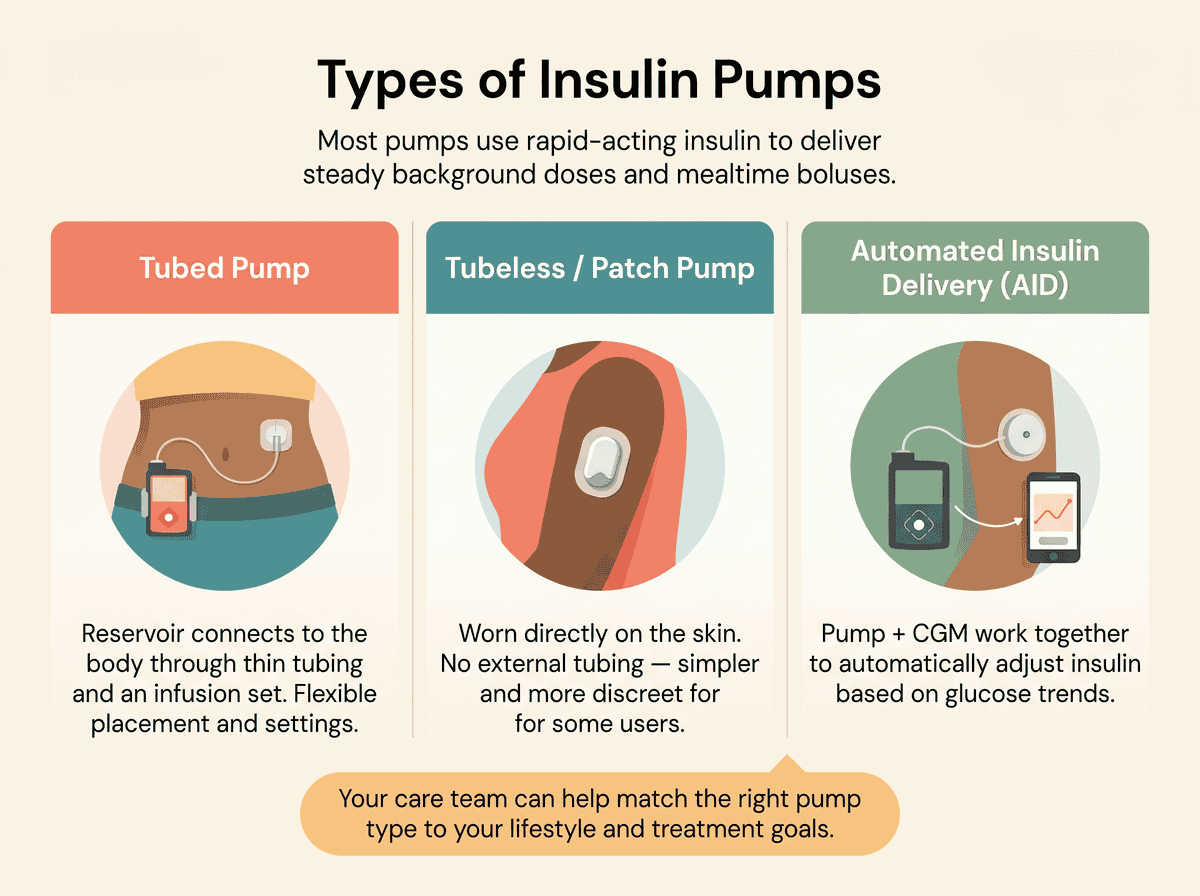
For the most part, insulin pumps use rapid-acting insulin.
They deliver tiny background doses throughout the day (acting like basal insulin).
In some cases, if it works for a patient’s treatment plan, some types of insulin pumps can also provide programmed boluses for meals and corrections.
There are a few different high-level insulin pump categories to be aware of.
They include:
Tubed pumps, which connect the insulin reservoir to the body using thin tubing and an infusion set.
They offer flexibility in placement and settings, but some people do find the tubing a little overly noticeable during daily activities.
Tubeless or patch pumps, which are worn directly on the skin and deliver insulin without external tubing.
This design can feel simpler or more discreet for some users, though insulin capacity and wear time may differ from tubed models.
Automated insulin delivery (AID) systems, when paired with a CGM, which combine pump data with continuous glucose monitoring to automatically adjust insulin delivery in response to glucose trends.
How To Use These Charts With Your Doctor (And Avoid Common Mix-Ups)
Now that you have these easy-reference documents and a clear way to understand and talk about the various types of insulin there are out there – what’s next?
Before you go to an appointment to discuss your diabetes care, even if you think you know all of this like the back of your hand, it helps to write down:
- Your insulin names and doses
- When you take each dose
- Patterns you notice (morning highs, overnight lows, post-meal spikes).
Then, helpful questions to bring to your appointment may include:
- “Is this insulin rapid-acting or long-acting?”
- “Does this one have a peak I should plan around?”
- “What should I do if I miss a dose?”
Finally, if you’re wondering how to actually fill your prescriptions in a timely, affordable manner, know that the team here at NorthWestPharmacy.com is ready to assist with some models of CGMs and various diabetes support medications in our online Canadian pharmacy and international store.
If you have any questions about your prescription or would like to chat with our on-staff pharmacists about your treatment, reach out!


