
How to Read Your Prescription Label: A Patient’s Guide
online pharmacy safety
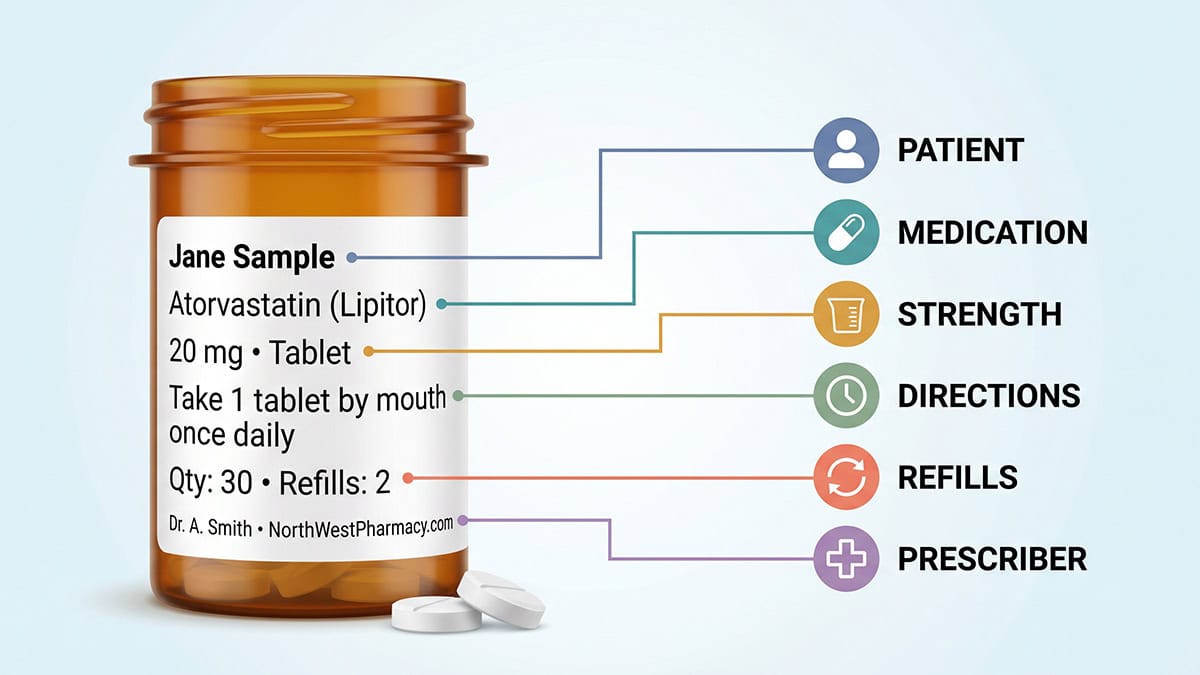
Prescription labels are easy to overlook.
They’re small, packed with text, and often printed in tiny font on the side of a pill bottle.
But that label is (pay attention, this is important!) one of the most important safety tools that comes with your medication.
Many dosing mistakes, missed doses, and avoidable side effects happen not because a medication is “wrong,” but because the prescription bottle label wasn’t fully understood.
If you’ve ever wondered whether you’re taking medication at the right time, in the right amount, or with the right precautions, you’re not alone.
Many, many people are out there searching for exactly how to read a prescription label.
Curious about how to do that efficiently, reliably, and well?
You’re in the right place.
This guide is designed to make prescription labels easier to understand at a glance.
Instead of long explanations, we’ll rely on charts and labeled examples to show you what each part of a prescription label means, why it matters, and what to double-check before you take a dose.
Throughout this article, you’ll see:
- A full prescription label example with each section clearly marked
- Simple charts explaining common directions and warning stickers
- Visual guides showing what a prescription label should contain
By the end, you should feel more confident reading your own prescription medicine labels and knowing when you need to ask more questions for 100% comprehension.
Prescription Label Basics: What You’re (Actually) Looking At
At first glance, a pill bottle prescription label can feel overwhelming.
There’s a lot of information in a very small space, and not all of it is written with patients in mind. Some parts are there to help pharmacists track prescriptions accurately, while other parts are critical for patients’ safe daily use.
(And there’s really no distinction between all of those parts!) That’s why it helps to think of a prescription label as having two main purposes:
- Identification, or making sure the right medication goes to the right person; and
- Instructions, or explaining how to take that medication safely.
The chart that accompanies this section breaks the label into clearly defined zones, so you can see what belongs where.
A Prescription Label Should Contain These Key Sections
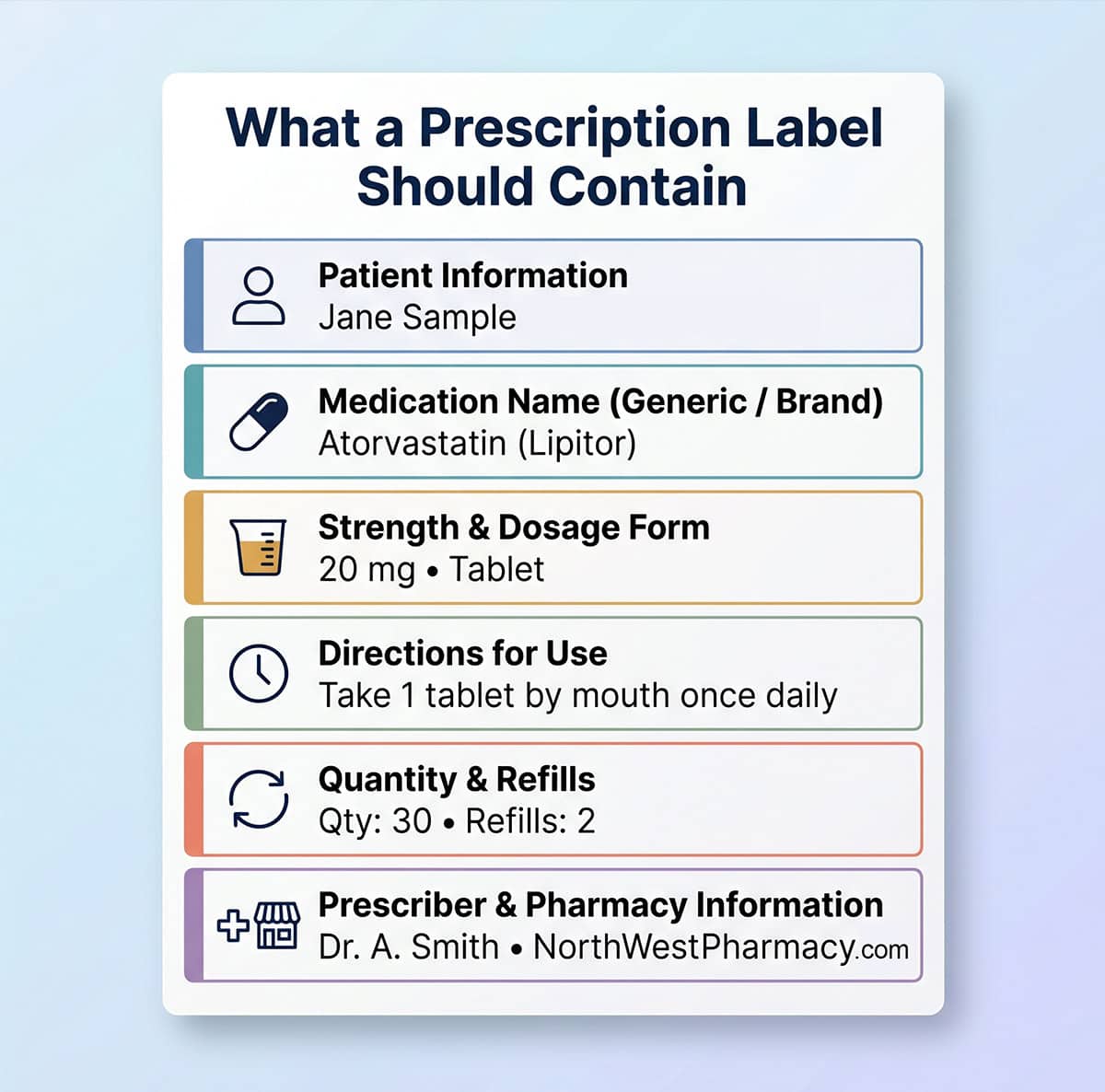
Most prescription labels follow the same basic structure, even if the layout or wording varies slightly by pharmacy.
Knowing what to look for (and in what order) makes it much easier to spot problems before they affect how you take your medication.
Here’s what you should see on your prescription label:
Patient Information
This section lists the name of the person the prescription was written for, and sometimes an additional identifier like their age, or an ID number.
Here’s why this matters:
Verifying the patient name is the single fastest way to prevent mix-ups, especially in households where more than one person takes daily medication.
Medication Name (Brand vs Generic)
Prescription labels may list the generic name of the medication, even if you recognize it by a brand name.
(So, for example, even if you know you’re taking Lipitor, your prescription may say atorvastatin on it, too.)
This can be confusing when refills look different from what you’re used to.
If you’re wondering if you have the right prescription, check in with your healthcare team (or feel free to reach out to our team of pharmacists at any time).
Strength and Dosage Form
This section of your prescription label tells you precisely how strong each pill, capsule, or milliliter is, along with the form the medication comes in.
Here’s why this matters:
Strength and dose are not the same thing.
Two prescriptions can look nearly identical but deliver very different amounts of medication!
Make sure that the strength and dosage listed on your prescription match what you and your doctor discussed.
Directions for Use
This is the most important – and most easy-to-misunderstand – part of the label.
The directions on your prescription label explain how much to take, how often, and sometimes when.
Here’s why this matters:
Common phrases like “take twice daily” or “as needed” can leave lots of unhelpful room open for interpretation.
Check out the chart we’ve added below to see common instructions translated into plain English so you know exactly what those directions usually mean in real life.
(But, as always, triple check with your healthcare team to make sure you’re on the same page.)
Quantity and Refills
This section shows how many doses were dispensed and how many refills remain.
Here’s why this matters:
Knowing this information helps you plan ahead and avoid gaps in treatment!
Prescriber and Pharmacy Information
Here, you’ll find the name of the clinician who prescribed you the medication and the pharmacy that filled it.
Here’s why this matters:
If you have questions, experience side effects, or need clarification, this tells you who prescribed the medication and is another point of contact for you.
It also helps you achieve and feel good about medication continuity if your prescription needs to be transferred or updated.
Prescription Label Example: Walking Through a Sample Bottle Step by Step
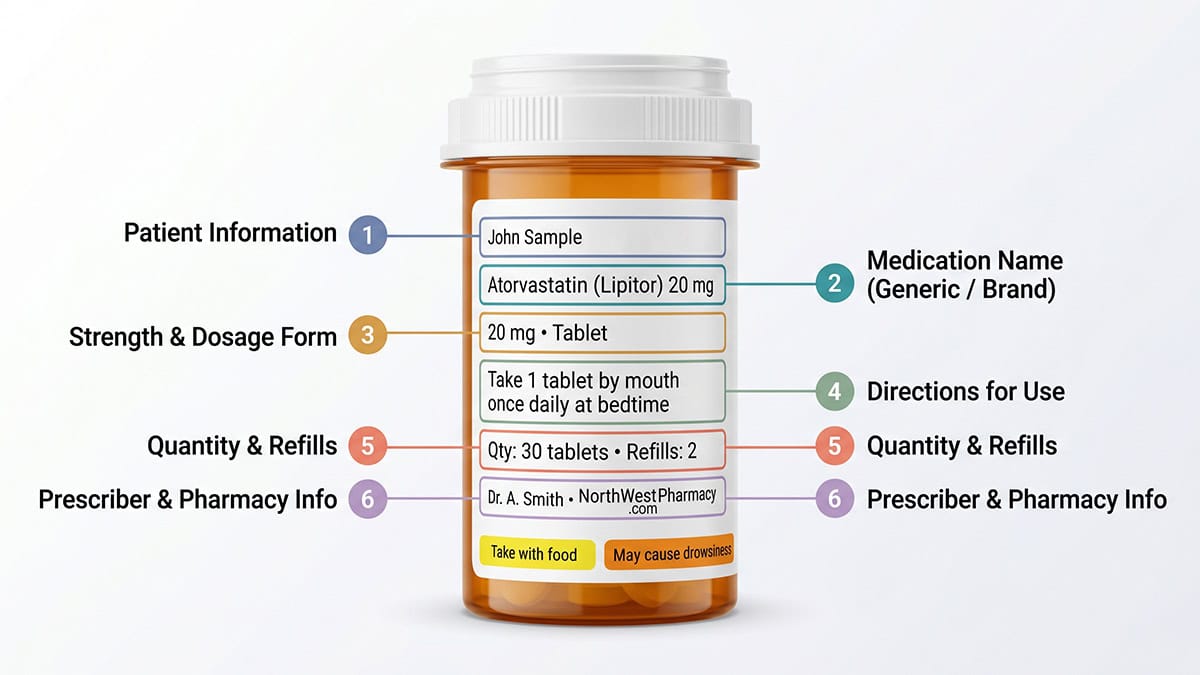
Reading about prescription labels is helpful, as is seeing a few visual aids of what the different parts of a prescription label look like.
However, seeing it all come together on one single example of a prescription label will make the information much easier to apply.
The sample shown in the accompanying chart is not a real patient’s label, it’s just a hypothetical example of what it might look like all put together.
Here’s how to read a prescription bottle label from top to bottom, using our hypothetical example as a guide.
Step 1: Verify the Patient Information
Start by checking the patient name, and making sure it matches yours (or the patient’s).
This may seem obvious, but it’s one of the most important safety checks, especially if multiple people in your household – e.g., people with similar names! – take differing medications, or if you’ve just picked up a new prescription.
Step 2: Confirm the Medication Name
Next, look at the medication name listed on the label.
Remember that this is often the generic name, even if you’re used to seeing a brand name on commercials or older bottles.
Step 3: Check the Strength
Find the strength listed next to the medication name, such as milligrams per tablet or milliliters per dose.
The strength tells you how much medication is in each unit (e.g., each pill or tablet), not how much you should take.
Step 4: Read the Directions Carefully
This is where most mistakes happen.
The directions printed on your prescription may include how often to take the medication, whether it should be taken with food, and any special timing instructions.
It’s easy to breeze through this section but take the time to read it carefully.
Often, you’ll find that directions that seem intuitive (like “always eat food right before you take this medication”) are ones you forget in practice, and they can make a huge difference in your experience.
Step 5: Review Quantity and Refills
Look for how many doses you received and whether refills are available.
Understanding this section can shield you from running out of medication unexpectedly. This section also helps you know when to contact your pharmacy or prescriber for more medication.
Step 6: Scan for Warnings and Stickers
Finally, look for any warning labels or stickers attached to the bottle.
These alerts flag important safety information that isn’t always repeated in the directions.
Wondering what the warnings you’re seeing actually mean?
Keep reading.
Next, we’ll take a closer look at warning labels and special boxes, including what people often mean when they ask about a “black box” on a prescription drug label – and how to understand those warnings without panic.
Prescription Warning Labels, Stickers, and Special Boxes (Including “Black Box” Warnings)
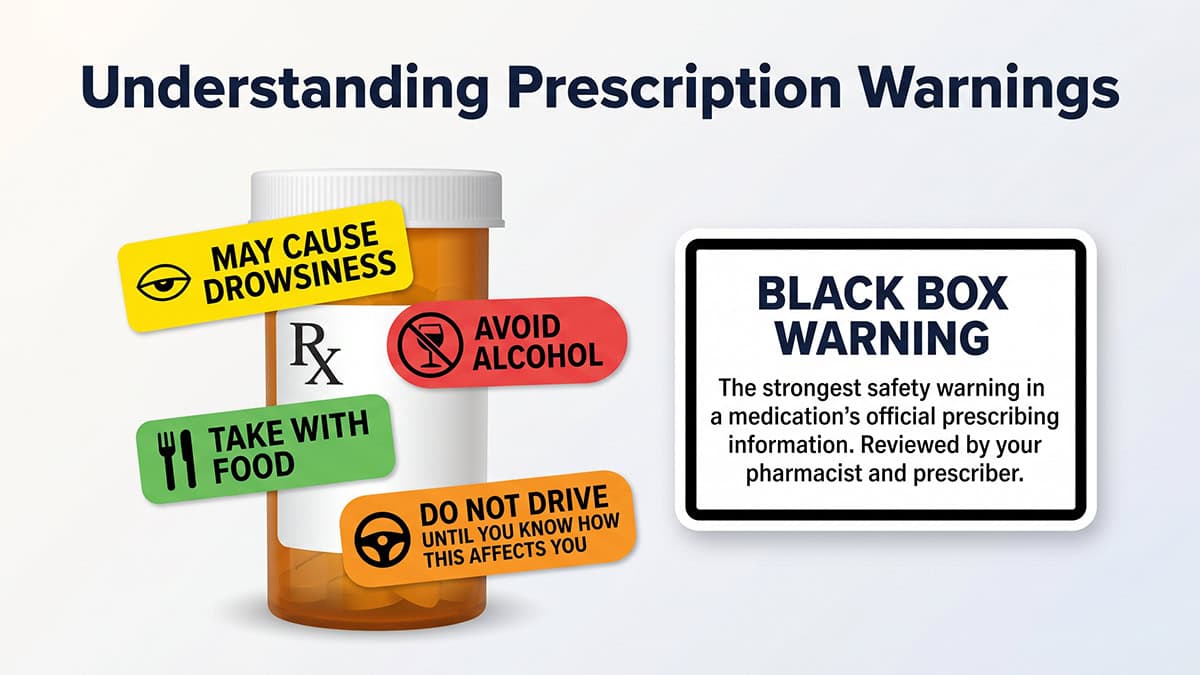
After the main prescription label, many bottles include extra stickers or highlighted boxes.
These are easy to ignore, especially if you’ve been taking your medication for a while, but they often contain important safety information.
Do you need to be concerned about these?
Probably not, if you’re using your medication according to your physician’s instructions.
However, it’s a good idea to be aware of what these black box warnings mean.
The following information and charts should help.
Common Warning Stickers on Prescription Bottles
These stickers are usually short, brightly colored labels added by the pharmacy.
They may include instructions such as:
- “May cause drowsiness”
- “Avoid alcohol”
- “Take with food”
- “Do not drive until you know how this medication affects you”
These warning stickers flag issues that don’t always fit neatly into dosing directions, or, alternatively, directions that your doctor may have given you but are very, very important to remember.
(In this latter case, the bright sticker is simply trying to serve as a helpful reminder.)
Here’s What People Mean by “A Black Box on a Prescription Drug Label”
A black box warning refers to the strongest safety warning included in a medication’s official prescribing information.
It does not usually appear as a literal black box on your pill bottle.
Instead, it’s part of the medication’s detailed regulatory labeling, which pharmacists and prescribers review when making treatment decisions.
When to Pause and Ask Questions
Some warnings deserve extra clarification, especially if they affect daily activities or other medications you take.
Know that it’s always (always!) reasonable to ask:
- Does this interact with other prescriptions or supplements?
- Should I avoid certain foods or alcohol?
- How might this affect driving, work, or sleep?
Common Prescription Label Mistakes Patients Make (And How Charts or Visual Aids Help Prevent Them)
Most prescription label mistakes aren’t reckless or careless.
They happen because – we’ll be the first to admit it! – labels are dense, abbreviated, and easy to skim.
This is where charts or visual aids like the ones we’ve provided in this piece are especially useful:
They slow things down and make important details harder to miss.
Some of the most common – and preventable – mistakes people make involving their prescription labels include:
Confusing dose with strength. Patients may see “10 mg” and assume that’s how much to take, without realizing the directions call for more than one tablet.
The comparison chart in this section may help you visually separate what’s in each pill from how many to take.
Assuming timing doesn’t (actually) matter. Instructions like “once daily” can feel flexible, but timing can affect how well a medication works or how it feels.
Overlooking “with food” or “avoid alcohol” instructions. These details are easy to miss when they appear as stickers rather than in the main directions.
Grouping warnings visually helps patients spot patterns that affect daily routines.
Ignoring refills until it’s too late! Many people don’t notice they’re out of refills until they’re nearly out of medication. This is also easy to fix – as long as you know where to get your refill information from!
Using the label as a reference, rather than something you glance at once and forget, can prevent many common problems.
How to Use Your Prescription Label to Ask Better Questions at Your Next Appointment

If you wield it correctly, your prescription label can be an instruction sheet and a conversation starter.
Before asking your provider medication questions, take a quick peek at that label again, and note:
- Your medication name and strength
- When you’re instructed to take it
- Any warning stickers that apply to your routine
Then, think carefully about how that information might apply to questions you may already have.
Common questions based on this info might include:
- “This says to just take the medication once per day. For me, is there a best time of day to take this?”
- “What does this warning mean for me specifically?”
- “Can I take this with my other medications or supplements?”
Ordering Prescriptions Safely and Accurately Online
When you fill your prescriptions through certified, trusted, established mail-order or online pharmacies, understanding exactly what’s on your prescription label becomes even more important.
That label is your primary reference for confirming that the medication you received matches what your doctor initially prescribed.
You might find it helpful to:
- Compare the label on the medication you receive to your original prescription before taking any medication
- Triple-check the name and strength of your medication with each refill
- Keep the label available when contacting a pharmacist
If you already have a valid prescription, the pharmacists at NorthWestPharmacy.com would be more than happy to help you review your prescription and answer any questions you may have before you order your medication.
Always remember:
If a label doesn’t make sense, that’s not a failure on your part. It’s a sign that it’s time to ask some educated questions!
The entire team here at NorthWestPharmacy.com looks forward to supporting you and your healthcare journey.


