
Contrave vs Wegovy: The Right Choice for You
speciality medications
Researching medications for weight loss?
You're not alone. The data shows that a lot of people are looking at these medications - and taking them, as, per the KFF, one in eight adults have reported taking a GLP-1 med. And, if you have looked up prescription medications for weight loss, you've definitely at least seen two medications come up on your list of Google results: Contrave and Wegovy.
These are, in fact, two pretty effective weight management prescription meds.
They're also two of the most well-known treatments out there today. However, the specific ways in which they help people achieve healthy weight management do differ quite a bit.
And that's important, because it means that depending on your unique biochemistry, lifestyle, and health goals, one medication over the other will probably be more helpful for you.
For example:
Some people are looking for an oral medication that helps reduce cravings and makes it easier to stick with healthier eating habits.
Others are interested in a medication that mimics natural hormones involved in appetite and fullness.
Each option is okay, of course - but the right option for you depends on far more than how much weight you hope to lose.
When comparing Contrave vs. Wegovy, you and your healthcare provider will also consider factors like:
- Your medical history
- Your other health conditions
- Your current medications
- Potential side effects (and your tolerance for them, which you should absolutely be aware of and respect)
- Your insurance coverage
- Your personal preferences, including whether you'd rather take a daily pill or a weekly injection - which you should also respect, not least because that will help boost your medication adherence!
Understanding how these medications differ can help you have a more productive conversation with your healthcare provider about which treatment may best fit your individual goals.
We're here to help. Let's get started.
Comparing Contrave vs. Wegovy: What Is Contrave?
Contrave is a prescription medication approved for chronic weight management in adults who are managing obesity or who are overweight. Typically, doctors prescribe Contrave for people who also have at least one weight-related medical condition, which may include high blood pressure, type 2 diabetes, or high cholesterol.
Contrave combines bupropion and naltrexone, two well-known mental health and addiction recovery medications, into one single extended-release tablet.
When taken together, these two meds act on areas of the brain involved in appetite regulation, food cravings, and reward.
Rather than directly changing digestion or metabolism, Contrave helps some people eat less by reducing cravings and making it easier to maintain healthier eating habits over time. But! It doesn't do that all by itself. To get the most out of Contrave, you should use it along a strategic, healthy weight management diet and consistent movement of your body.
Comparing Contrave vs. Wegovy: What Is Wegovy?
Wegovy is the brand name for semaglutide, a prescription medication approved for chronic weight management in certain adults and adolescents who meet specific eligibility criteria.
If “semaglutide” sounds familiar, congratulations - that's a further sign that you've been doing your research. Semaglutide is a GLP-1 active ingredient.
GLP-1 is a hormone your body naturally produces after eating. It helps regulate appetite, slows the movement of food through the stomach, and signals the brain that you're full.
Wegovy mimics the action of this hormone.
(You'll also find GLP-1s in medications Ozempic and Mounjaro. Wegovy is the brand GLP-1 med most specifically formulated for weight loss.)
As a result, after taking Wegovy as recommended by their doctors, many patients do experience:
- Reduced appetite
- Increased feelings of fullness
- Smaller meal sizes
- Less frequent hunger between meals
But the base active ingredient isn't the only big difference between Wegovy and Contrave.
They also differ in the way they are administered - or how you, as the patient, would get that active ingredient into your body.
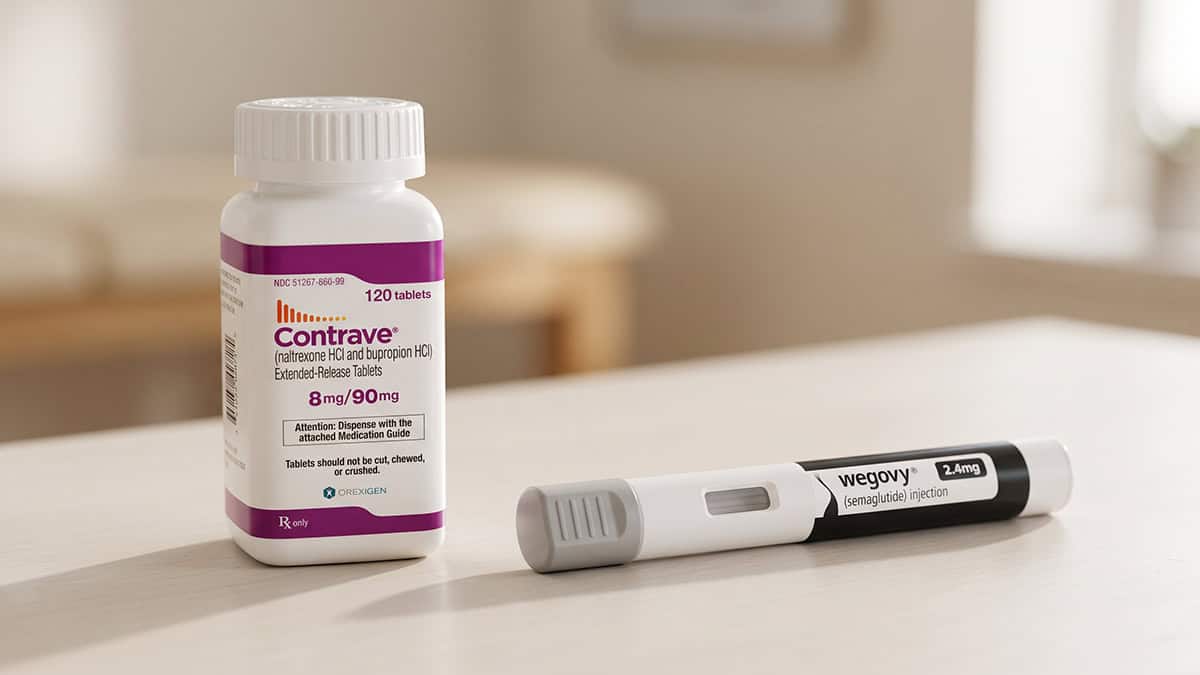
Contrave is an oral tablet taken daily according to a gradual dosing schedule. It's meant to be a gentle way to ramp-up your body to the drug (which can reduce side effects). It's also meant to be convenient, as a simple pill you can take by yourself at home.
Wegovy is a bit more complicated.
To take it, you need to be comfortable with self-administration of a once-weekly injection using a prefilled injection pen.
That said, just as is the case with Contrave, Wegovy does typically follow a ramp-up dosage to help you get used to the drug.
Contrave vs. Wegovy: How They Work
Both Contrave and Wegovy support long-term weight management.
But they do so in different ways.
We've discussed how they differ in administration.
How do Contrave vs. Wegovy stack up in terms of basic mechanics?
Here's How Contrave Works
Contrave, thanks to its formulation of naltrexone and bupropion, stimulates nerve cells in the brain and blocks feedback signals that would otherwise block those nerve cells from doing their job.
As a result, Contrave can:
- Reduce appetite
- Decrease food cravings
- Make it easier to control portion sizes
- Support healthier eating habits over time
Important to know that Contrave doesn't do this by increasing your metabolism or preventing your body from absorbing calories, like other weight management meds might.
Instead, it simply helps some people consume fewer calories by shifting the way their brains respond to hunger cues.
Here's How Wegovy Works
Wegovy works very differently.
Its active ingredient, semaglutide, mimics GLP-1, a hormone naturally released after eating.
GLP-1 helps regulate appetite by:
- Increasing feelings of fullness
- Slowing stomach emptying
- Reducing hunger signals
- Helping people stay satisfied for longer after meals
Often, after a person starts taking Wegovy, they notice that they naturally eat smaller portions since they feel full sooner and have that feeling of fullness for a longer period of time.
Which Medication Is More Effective - Contrave vs. Wegovy?

This is the biggest question you'll see out there. (It's probably the one you're asking yourself.)
On an objective level, there is some evidence indicating that for weight loss numbers alone, Wegovy might be more effective … in that it may produce greater average weight loss than Contrave.
But, of course, objectivity doesn't really have much of a place in personalized weight management solutions. And averages don't tell the whole story.
Your individual results with these types of medications will vary depending on specific-to-you factors, like your:
- Starting weight
- Diet and physical activity
- Underlying medical conditions
- Medication adherence
- Individual response to treatment
Some people respond exceptionally well to Contrave and appreciate that it just involves a pill they take at home.
Others achieve greater success with Wegovy's appetite-suppressing effects and are more comfortable with a weekly injection.
There's also the fact that the number on a scale isn't the only benchmark of success that you and your doctor should be considering when you're making a prescription medication decision.
You also need to consider your:
- Long-term safety
- Existing medical conditions
- Side-effect profile
- Medication interactions
- Insurance coverage
- Patient preference
There are situations in which opting for a drug that delivers a slower weight loss might be better for you and your long-term safety or side effect tolerance.
Which, speaking of: What side effects come with these two weight management medications?
Side Effects Comparison: Contrave vs. Wegovy
Since Contrave and Wegovy work very differently in service of similar goals, the side effects they can trigger are also quite different. Good to know when you're trying to figure out which of the two will work best for you!
Here's what to expect.
Common Contrave Side Effects
Contrave tends to cause side effects involving the digestive system and central nervous system.
When patients go on Contrave, they may report the following:
- Nausea
- Constipation
- Headache
- Dry mouth
- Dizziness
- Difficulty sleeping (insomnia)
As the human body gets used to the new medication, though, these Contrave side effects should fade over time.
Common Wegovy Side Effects
Wegovy also causes digestive side effects, especially when you're just starting the med or if you're increasing your dosage.
Typical Wegovy side effects may include:
- Nausea
- Vomiting
- Diarrhea
- Constipation
- Abdominal pain
- Indigestion
Because Wegovy slows stomach emptying - e.g., provides that sense of fullness for longer - gastrointestinal symptoms are among the most common reasons patients contact their healthcare providers during the early stages of treatment.
Comparing Contrave vs. Wegovy Side-By-Side
We've provided a lot of information about the pros and cons of each medication, but sometimes it can be helpful to see at a glance what the basic information about your options are.
Here are some quick bullets that should help.
How do Contrave and Wegovy differ in…
- Administration? Contrave is an oral tablet you take once a day. Wegovy is an injected medication that you'll need to perform once per week.
- Side effects? Contrave is more commonly associated with headaches, dry mouth, insomnia, and dizziness. Wegovy tends to be associated with gastrointestinal symptoms like nausea and diarrhea.
- Active ingredients? Contrave contains bupropion and naltrexone; Wegovy contains semaglutide.
- Medical history concerns? Contrave is usually not a good fit for people with seizure disorders or opioid use. Wegovy may not be a good fit for people with endocrine conditions or thyroid disorders.
Are You a Better Candidate for Contrave vs. Wegovy?
With the caveat, of course, that the only way to answer this question for sure is to talk with your specific doctor?
There's no one-size-fits-all answer to this question, but there are a few general best practices we can look at.
Your Doctor Might Recommend Contrave for You If …
- You prefer an oral medication.
- Food cravings or reward-driven eating are significant challenges for you.
- Long-term weight management is your goal.
- You don't have any contraindications to bupropion or naltrexone.
Your Doctor Might Recommend Wegovy for You If…
- You're more comfortable using a weekly injection.
- Greater average weight loss is a very important treatment goal for you.
- Your unique medical history makes a GLP-1 receptor agonist an appropriate (and safe) option to consider.
- You don't have any contraindications or precautions that would make semaglutide unsuitable.
These examples are general rather than prescriptive.
Remember, the best medication for you depends on preferences and considerations specific to you.
You might not mind weekly injections. For others, that might be a nonstarter. Bring your concerns and goals to your doctor and talk it out. Doing that is the best possible way to make sure you get a prescription that works for you!
Questions to Ask Your Healthcare Provider About Contrave and Wegovy

When you go to your appointment to talk about your medications, you have a daunting task ahead of you.
There'll be a lot for you and your provider to discuss - and, likely, you'll only have a scant few minutes in which to have that conversation.
Going in with some prepped questions should help.
Consider these, and add others of your own:
- Which medication - Contrave vs. Wegovy - is more appropriate for my medical history?
- Which side effects am I most likely to experience?
- Would a daily pill or a weekly injection be a better fit for my lifestyle?
- How much weight loss is realistic for me?
- How will we monitor my progress?
- Will my insurance cover either medication?
- If one medication doesn't work well for me, what other options are available?
Comparing Contrave vs. Wegovy for Your Health
When comparing Contrave vs. Wegovy, it's easy to focus on one question:
Which medication helps people lose more weight?
While that's an important consideration, it's only one piece of the decision.
Contrave and Wegovy work through completely different mechanisms.
Contrave targets brain pathways involved in appetite, cravings, and food reward, while Wegovy mimics a naturally occurring hormone that increases fullness and slows stomach emptying.
Some people prefer the convenience of a daily oral medication. Others are comfortable with a weekly injection if it aligns with their treatment goals. Medical history, existing health conditions, side-effect profiles, insurance coverage, and personal preferences all influence which medication may be the better fit.
Ultimately, the right medication is the one that safely supports your long-term health goals.
If you're deciding between Contrave and Wegovy, talk with your healthcare provider about the potential benefits and risks of each option.
Then, once you have a valid, updated prescription for the medication of your choice, head to our prescription medication pages and follow the prompts for a simple checkout experience.
The entire team here at NorthWestPharmacy.com looks forward to supporting you and your healthcare goals.


