
Vtama vs Zoyrve vs Opzelura: Vtama Alternatives Compared
speciality medications
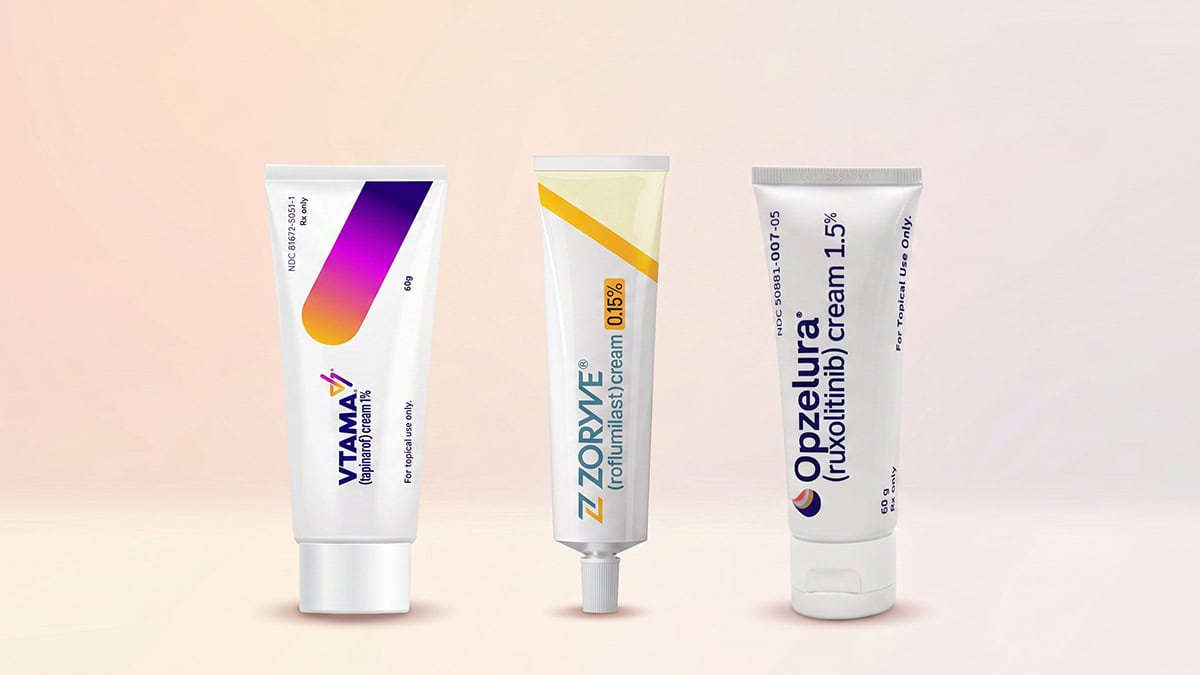
Vtama. Zoryve. Opzelura.
Read the three names, do a little research, and you might notice something confusing right away.
All three of these are newer prescription skin creams.
All are non-steroidal.
All seem to be used for inflammatory skin conditions.
But they’re not all the same medication.
That’s precisely why – you might have also noticed – that there’s a lot of buzz in the prescription skincare world about pitting these medications against each other (Vtama vs Zoryve! Vtama vs Opzelura!).
People want to know:
- Which condition each medication (... actually) treats
- Whether one works better than another
- How they compare to traditional steroid skin creams
- What alternatives exist if one option isn’t the right fit
The good news is that there are now more treatment choices available for chronic skin conditions like psoriasis and eczema than ever before.
The challenge is, therefore, understanding how these medications differ and where each one fits into treatment.
In this guide, we’ll break down:
- What Vtama, Zoryve, and Opzelura are used for
- How they work in plain English
- Key differences between them
- Common Vtama alternatives used in psoriasis treatment
- How doctors decide which type of topical medication may be appropriate
What Is Vtama?
Vtama (tapinarof) is a prescription non-steroidal topical cream used to treat plaque psoriasis.
Plaque psoriasis, itself, is a chronic inflammatory skin condition that can cause:
- Thickened plaques
- Redness and inflammation
- Scaling or flaking skin
- Itching and irritation
Vtama helps manage these symptoms by targeting inflammatory pathways involved in psoriasis.
Unlike topical steroids, however, Vtama works through a different mechanism and does not rely on corticosteroids to reduce inflammation. (A bit later in this piece, we’ll talk about why people might want a psoriasis treatment option that’s non-steroidal.)
Specifically, Vtama interacts with a pathway in the body called the aryl hydrocarbon receptor (AhR) pathway. By working directly with that pathway to keep immune activity in check and calm down any skin cell issues that are happening at that zoomed-in cell behavior level, Vtama can reduce plaque formation over time.
You can buy brand Vtama through NorthWestPharmacy.com for about $700.00 for a 60g supply.
Now, let’s take a quick look at a similar-but-different plaque psoriasis medication.
What Is Zoryve?
Zoryve (roflumilast) is another newer non-steroidal topical medication. Much like it is here, Zoryve tends to crop up whenever Vtama gets mentioned.
Like Vtama, Zoryve is used in inflammatory skin conditions, including plaque psoriasis.
Certain formulations of Zoryve may also be used in conditions like seborrheic dermatitis but this depends heavily on the philosophy and preferences of your dermatologist (as well as your unique skincare journey and health goals).
While they are quite similar, Zoryve does work a bit differently from Vtama.
Zoryve is a PDE4 inhibitor.
So, it inhibits the PDE4 pathway. This helps reduce inflammatory signaling inside your skin. In even simpler terms, it works by calming down chemical signals that contribute to redness, irritation, and plaque formation.
Although both medications are steroid-free, they target inflammation through different biological pathways.
That means a patient who responds well to one medication may not necessarily respond the same way to the other. (Which can be a good thing: If you don’t respond to one, checking the other out may be worth a try.)
You can buy brand Zoryve through NorthWestPharmacy.com starting at about $410.00 for a 60g supply.
What Is Opzelura?
Opzelura (ruxolitinib) is another prescription topical medication that often comes up in conversations about newer steroid-free skin treatments.
Opzelura gets compared to Vtama, specifically, quite often, because of that non-steroidal value add.
Here’s what makes Opzelura different:
Opzelura is a topical JAK inhibitor, which means it works by blocking specific inflammatory signaling pathways involved in immune activity.
Unlike Vtama (which is primarily used for plaque psoriasis), Opzelura is more commonly associated with atopic dermatitis (or eczema) and, in certain cases, vitiligo.
This distinction matters because psoriasis and eczema are not the same condition, even though they can sometimes look similar to patients.
You can buy brand Opzelura through NorthWestPharmacy.com for about $1,600.00 for a 100g supply.
Vtama vs Zoryve: Here’s Exactly How They Compare
As you’re seeing, these meds have a lot in common!
Let’s take a specific look at how Vtama and Zoryve compare and contrast.
The biggest overlaps between Vtama and Zoryve are that they are both:
- Prescription topical medications
- Non-steroidal
- Used in plaque psoriasis treatment
But beneath those similarities are important differences.
The Two Meds Have Different Mechanisms of Action
The clearest distinction is how the medications work.
Vtama works through the aryl hydrocarbon receptor (AhR) pathway.
Zoryve works as a PDE4 inhibitor.
Both approaches aim to reduce inflammation, but they target different signaling processes inside the skin.
There Are Also Differences in Side Effects Between the Two

Both Vtama and Zoryve are localized topical treatments.
They can trigger different side effect profiles.
With Vtama, one of the more commonly discussed effects is folliculitis, or small bumps around your hair follicles.
With Zoryve, patients may experience:
- Mild irritation
- Redness
- Application-site discomfort
Vtama vs Opzelura: How Do They Stack Up?
At first glance, the two medications are very, very similar.
- Both are newer prescription topicals
- Both are non-steroidal
- Both are designed to manage inflammatory skin conditions
Clinically, Vtama and Opzelura often serve different roles.
Vtama is mainly associated with plaque psoriasis, while Opzelura is primarily used for eczema (atopic dermatitis) and certain cases of vitiligo.
The confusion usually comes from the fact that patients are increasingly looking for:
- Alternatives to steroids
- Treatments suitable for longer-term use
- More targeted therapies for chronic skin conditions
Because both medications fit into that broader trend, they’re often discussed together even when their approved uses differ.
Is Vtama Better Than Zoryve or Opzelura?
One of the most common questions patients ask is whether Vtama is better than Zoryve or Opzelura.
The reality is that there is no single best option for every person or every skin condition.
Choosing a treatment depends on several factors, including:
- Your exact diagnosis
- The severity of your symptoms
- Which parts of your body are affected
- Your previous treatment history
- Your skin sensitivity and tolerability
- Your long-term treatment goals
For example…
… A patient with plaque psoriasis may discuss Vtama or Zoryve with their provider
… A patient with eczema may be more likely to discuss Opzelura
Even among psoriasis treatments, what works well for one person may not work the same way for another. Some patients prioritize avoiding steroids, while others need faster short-term symptom control.
This is why dermatology treatment plans are often highly individualized rather than based on a one-size-fits-all approach.
Common Vtama Alternatives for Psoriasis
Vtama, Zoryve, and Opzelura aren’t the only medications that people use to treat plaque psoriasis.
Here are just a couple for your consideration – or for you to bring to your doctor. Some of these are newer therapies, while others have been used in psoriasis care for many years.
Calcipotriene
Calcipotriene is a topical medication that helps manage and work with vitamin D activity in the skin.
It helps slow the excessive growth of skin cells that contributes to plaque formation in psoriasis.
It’s commonly used for:
- Mild-to-moderate plaque psoriasis
- Maintenance therapy
- Combination treatment approaches
Compared to Vtama, calcipotriene has been available much longer and is a more established option in psoriasis care.
Calcipotriene + Betamethasone
Combining some of these medications (under the watchful eye of your doctor) can be a strategic approach.
For example, mixing calcipotriene and betamethasone – which is a steroid – can:
- Reduce inflammation quickly
- Slow skin cell overgrowth
- Improve plaque appearance through multiple mechanisms
These products may work faster for some patients.
But because this approach relies on topical steroid use, it can come with some of the downsides of topical steroid use that people try to avoid with the likes of Vtama. (Just something to think about!)
Tazarotene
Tazarotene is a topical retinoid sometimes used in plaque psoriasis treatment.
Taking it as directed by your doctor may help improve:
- Thickened plaques
- Scaling
- Skin texture
However, tazarotene can also cause irritation in some patients, particularly during early treatment.
Like many psoriasis medications, it may be used alone or in combination with other therapies depending on the situation.
Clobetasol Propionate
Clobetasol propionate is a high-potency topical steroid commonly used for psoriasis flares.
It can be very effective for:
- Rapid symptom relief
- Thick or stubborn plaques
- Short-term flare management
However, because it is a potent steroid, just be aware that long-term or excessive use can increase the risk of steroid-related symptoms, like stretch marks and skin fragility.
Halobetasol Propionate
Halobetasol propionate is another strong topical steroid used for psoriasis treatment.
Like clobetasol, it is often reserved for:
- More persistent plaques
- Short-term control of inflammation
- Areas requiring stronger therapy
Because these medications are powerful, they are typically used carefully and according to provider instructions.
Steroid vs Non-Steroid Psoriasis Treatments
For a very long time, topical steroids were the mainstay of psoriasis treatment.
They can reduce inflammation very, very quickly.
These topical steroids include such meds as clobetasol propionate, halobetasol propionate, or betamethasone-containing combinations.
And these medications are, in fact, still widely used today!
So – why is it that so many people are still leery of using topical steroids?
Here’s why:
Long-term steroid use can come with limitations, including:
- Skin thinning
- Increased skin sensitivity
- Stretch marks in certain areas
- Restrictions on use in delicate regions like the face
Newer non-steroidal options generate a lot of buzz very specifically because they allow psoriasis patients to neatly sidestep these limitations.
What Non-Steroidal Options Do I Have?
Your non-steroidal options include Vtama, Zoryve, and Opzelura.
These come with several benefits, like avoiding steroid-related skin thinning, enjoying more flexibility for longer-term management in some patients, and deploying different cellular mechanisms that target skin inflammation in new, and perhaps more effective or at least more targeted, ways.
How Long Do These Medications Take to Work?
Much like “so what will this medication feel like on my skin” and “what side effects do I need to look out for,” a key question you’re probably asking is – how long do you need to stick with meds like Vtama and Zoryve before you see results?
With medications like Vtama and Zoryve, improvements are usually gradual rather than immediate.
That said, within a few weeks, many patients notice changes in plaque thickness, redness, or scaling over the course of several weeks.
Topical steroids may sometimes provide faster visible relief, especially during severe flares, but they are not always intended for continuous long-term use.
A List of Specific Questions to Ask Your Doctor Before Switching Treatments

Thinking about switching from a steroid psoriasis treatment to something with a different side effect profile?
That can make a lot of sense – but remember that the grass isn’t always greener.
And, of course, navigating that conversation with your doctor can be tricky.
A few questions can help guide the conversation.
Take these to your next appointment:
- Is my condition definitely psoriasis, eczema, or something else?
- Why are you recommending this medication specifically?
- Is this intended for short-term or long-term use?
- What side effects should I watch for?
- Can this medication be combined with other treatments?
- How long should I try it before evaluating results?
How Much Do Psoriasis Medications Cost Again? Buying Medications From Canada
If you’re reeling from sticker shock regarding any of these medications, know that that’s a reasonable response to the prices on this page.
Unfortunately, in many cases, that’s how much medications in the United States cost.
(There are laws that make it very difficult to regulate medication prices, and the lack of simple international sourcing as well as extremely complex supply chain logistics make it very easy to keep prices high.)
To get the medication and the relief you deserve, it’s worth it to check out what’s available through an online and international and Canada pharmacy website. Here, through NorthWestPharmacy.com, you can access your brand-name prescription medications with savings up to 80% when compared to typical American brick-and-mortar stores.
If you’re ready to buy your non-steroidal plaque psoriasis treatment, we’re here to assist.
Check out our Vtama, Zoryve, and Opzelura pages to learn more about these meds or contact our friendly team of customer support specialists if you have any questions!
All of us here at NorthWestPharmacy.com are ready to help support your skincare needs.


