
You don’t necessarily have to run until you’re breathless to improve your cardiovascular health. In fact, exercising at a moderate, comfortable, and sustainable level of intensity— known as Zone 2 training—can generate significant improvements in your cardiovascular health and capacity.
Although the term “Zone 2” has become popular in fitness circles, the underlying concept isn’t new. Moderate-intensity aerobic exercise has long been a cornerstone of cardiovascular disease prevention and cardiac rehabilitation.
What Is Zone 2 Training?
Exercise intensity is sometimes divided into five heart-rate zones. Zone 1 represents very easy activity, while Zone 5 represents near-maximal effort. Zone 2 falls toward the easier end of this spectrum.
Zone 2 training involves getting your heart rate to 60% to 70% of your maximum heart rate and keeping it steady at that intensity. Zone 2 aerobic exercise is challenging enough to make your heart and lungs work harder but easy enough to continue for an extended period. Walking briskly, cycling, swimming, jogging, rowing, and using an elliptical machine can all qualify as Zone 2 exercise.
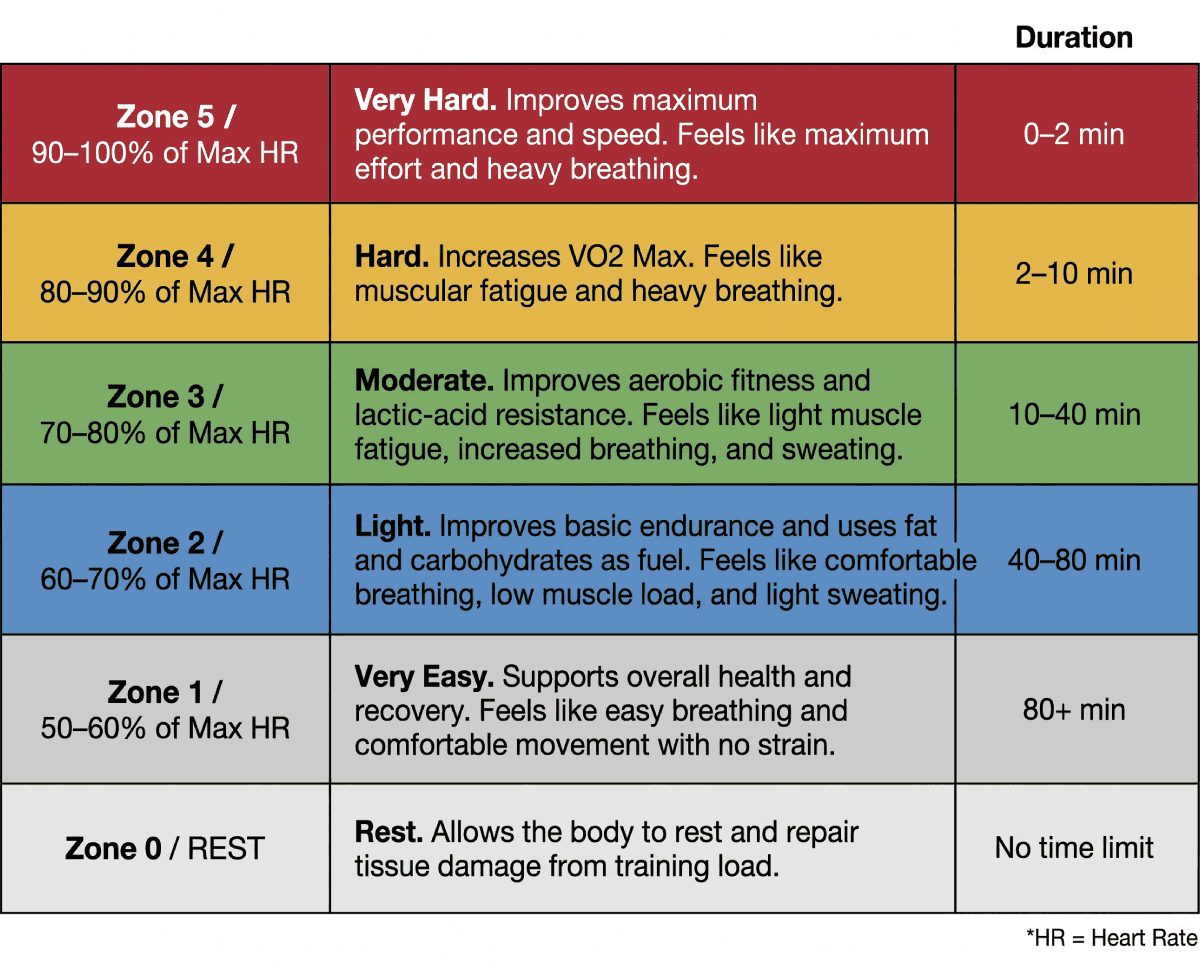
A practical way to see if you are in zone 2 during aerobic exercise is the “talk test.” During Zone 2 exercise, you should be breathing harder than you would at rest but still able to speak in complete sentences. If you can barely get out a few words, you’re probably exercising above Zone 2. If you can sing, your intensity is too low.
Heart-rate monitors can also provide a way to ensure you’re in the zone. Your maximum heart rate can be estimated by this formula: 220 – your age. For Zone 2 training, you would strive to keep your heart rate between 60% and 70% of your maximum. For example, a 50-year-old person would have a maximum heart rate of 170 (220 – 50), and 60% to 70% would mean keeping their heart rate between 102 and 119 to be in their Zone 2.
Why Your Heart Benefits From Aerobic Training
Regular aerobic exercise (physical activities that make you breathe harder and raise your heart rate) makes the cardiorespiratory system (i.e., the heart, lungs, and circulatory system) more efficient. Over time, the heart becomes better able to pump blood, the lungs increase their capacity and efficiency, the blood vessels become more flexible, and muscles become more effective at using oxygen.
Cardiorespiratory fitness is such a powerful predictor of health that the American Heart Association has advocated treating it as a “vital sign.” There is extensive research evidence supporting the value of regular aerobic exercise for physical and mental health. For example, a 2025 systematic review involving 3.8 million observations found that higher cardiorespiratory fitness was strongly associated with lower risks of both cardiovascular and all-cause mortality. In other words, improving your ability to exercise is not merely about athletic performance—it’s associated with living longer.
Zone 2 Builds Your Aerobic Engine
One reason endurance athletes spend substantial amounts of time exercising at lower intensities is that these workouts help build their “aerobic base.” Your aerobic base is your body’s capacity to use oxygen to fuel steady exercise over a long time, relying on burning fat for energy.
Zone 2 exercise also allows you to exercise without the fatigue produced by high-intensity workouts. A 40-minute brisk walk, for example, may be easier to repeat several times each week than a series of exhausting interval workouts. For many people, the exercise program they can consistently maintain will ultimately be more valuable than a theoretically “optimal” program they abandon after several weeks.

During lower-to-moderate intensity exercise, muscles obtain a relatively large proportion of their energy by oxidizing fatty acids. With regular training, the body becomes more efficient at switching between fats and carbohydrates as energy sources.
Aerobic exercise can also improve insulin sensitivity and glucose regulation. These effects are particularly important because insulin resistance, type 2 diabetes, obesity, and cardiovascular disease frequently occur together.
Regular moderate aerobic activity can additionally contribute to improvements in blood pressure, lipid profiles, body composition, and vascular function—all factors that influence long-term cardiovascular risk.
Is Zone 2 the “Best” Exercise?
This is where some popular claims about Zone 2 get ahead of the scientific evidence. A 2025 review in the medical journal Sports Medicine concluded that current evidence does not demonstrate that Zone 2 is uniquely optimal for cardiorespiratory fitness. In fact, higher-intensity exercise can produce equal or greater improvements in some measures, particularly when people have limited time to exercise.
So, the lesson should not be that everyone needs to perform all—or even most—of their exercise in a precisely calculated heart-rate zone. Rather, Zone 2 is one practical way to add to your lifestyle the moderate-intensity aerobic activity strongly supported by health research.
The Bottom Line
Zone 2 training has become fashionable, but the principle behind it is reassuringly simple: you do not have to exercise at maximum intensity to strengthen your cardiovascular system.
Comfortable, sustained aerobic activity can help improve cardiorespiratory fitness, metabolic health, and exercise capacity while being relatively easy to recover from and repeat.
The strongest scientific evidence supports regular physical activity across a range of intensities. For long-term cardiovascular health, Zone 2 is best viewed as one highly practical component of a broader exercise program.
References:
Sports Medicine medical journal
World Health Organization website
American Heart Association website
Journal of Sport and Health Science medical journal
